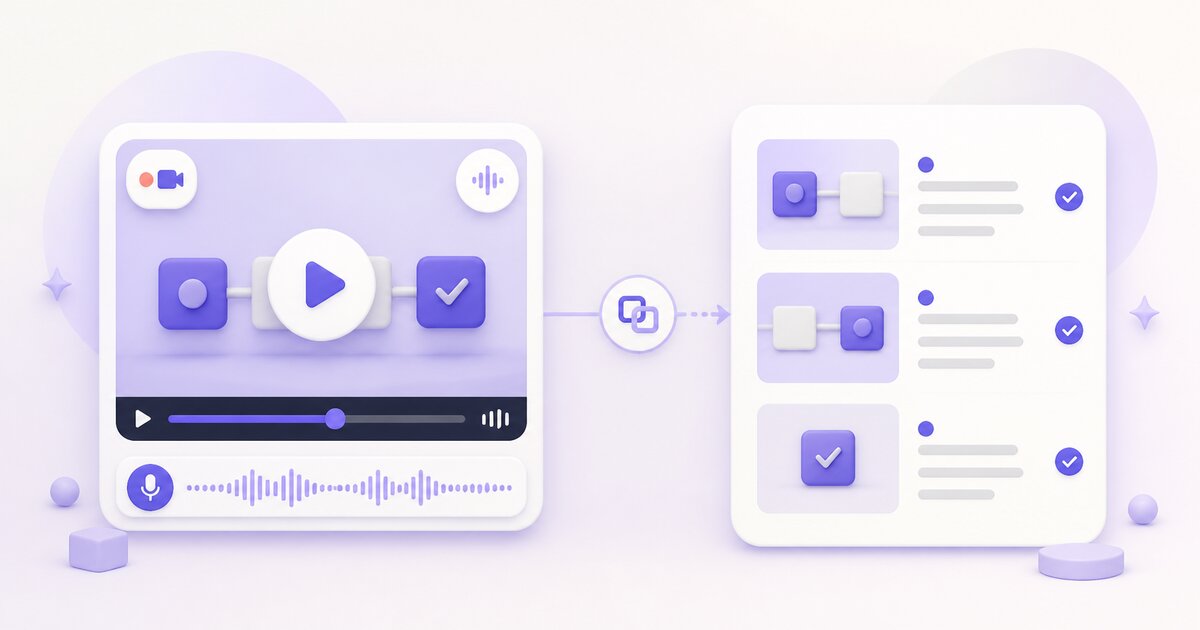
Choose Loom when the explanation depends on voice, motion, context, or judgment. Choose Scribe when the reader needs a repeatable, searchable procedure with numbered steps and screenshots. Loom produces a video; Scribe produces a document.
Neither format wins every time. A two-minute design critique is natural as video. A 17-step expense procedure is easier to scan as a guide. The decision should follow what the audience must do after opening it.
Loom and Scribe compared
| Question | Loom | Scribe |
|---|---|---|
| Primary artifact | Screen-and-camera video with audio | Written step-by-step guide with screenshots |
| Capture method | Record the screen, camera, and microphone | Perform a web or desktop process while Scribe captures actions |
| Best context | Tone, reasoning, demonstrations, feedback, updates | Repeatable procedures, SOPs, onboarding, software instructions |
| Viewer behavior | Watch linearly or scrub to a moment | Scan headings and jump directly to a step |
| Editing | Video trim, stitch, transcript and AI editing by plan | Edit steps, text, screenshots, annotations, and redaction by plan |
| Search and reuse | Transcript and generated AI artifacts | Text-native document that can be searched and updated |
| Sharing | Hosted video link and embed | Hosted guide link and embed |
| Exports | Video download on paid plans | PDF, HTML, and Markdown on paid Pro plans |
| Free tier | 25 recordings, five minutes each | Browser capture and shareable guides |
| Paid entry | Business $18/user/month on monthly billing | Pro Personal $35 monthly or $25/month billed yearly |
Need a format that fits the job? If you want a narrated walkthrough, Chairkick can help you record and share it in the browser. Record a walkthrough
Prices are public US list prices checked in August 2026. Scribe Pro Team is currently $17 per seat monthly or $13 billed yearly and begins at five seats. Loom Business + AI is $24 per user monthly.
Where Loom is the better format
Video carries information that a screenshot guide strips away:
- the tone of feedback on a design or proposal;
- movement, timing, animation, and audio behavior;
- a quick tour through several loosely connected areas;
- a person’s reasoning while diagnosing a bug;
- a status update where the point is context rather than exact clicks;
- a sales or customer message where a human presence matters.
Imagine reviewing a new checkout. “Move this button” could be a written instruction, but the useful part may be why the hierarchy feels wrong, how the user arrived there, and what tradeoff the designer should preserve. A short narrated video communicates that nuance quickly.
The cost is retrieval. A viewer who returns next month to find one setting may have to scrub through the timeline. A transcript helps, and Loom’s current Starter plan includes transcription, but a video remains fundamentally sequential.
Where Scribe is the better format
Scribe observes a process and turns actions into numbered steps with screenshots. That output is well suited to:
- standard operating procedures;
- employee onboarding and internal software instructions;
- customer help-center articles;
- “do this exactly” administrative tasks;
- workflows readers will repeat without the author present;
- documents that must be exported, edited, or reviewed as text.
A reader can see the length before starting, scan for step seven, and compare the screenshot with the current interface. An editor can update one instruction without re-recording a whole narration.
The tradeoff is context. Automatic capture is good at recording what was clicked, but the author still needs to explain why a choice matters, what exceptions exist, and what to do when the screen differs. A generated procedure should be reviewed like any other documentation.
Capture and editing differences
Loom captures continuous time. When an author pauses, backtracks, or opens the wrong menu, those moments exist in the recording until edited. That can feel natural in quick communication and untidy in permanent training material.
Scribe captures discrete actions. It creates a sequence that can be reordered, retitled, annotated, redacted, or deleted. Browser workflows are available on the free Basic plan; Scribe’s pricing page places desktop and mobile capture, branding, screenshot editing, and exports on paid Pro plans.
This affects maintenance. A single changed button may require replacing one Scribe screenshot and sentence. In a tightly edited video, the same interface change may require a patch, a new segment, or a complete re-recording. Conversely, explaining a complex animation in static screenshots can require far more writing than simply showing it.
Sharing, accessibility, and exports
Both products provide hosted links and embeds. With either tool, check the recipient’s access in a private browser before publishing documentation. A link that works for a signed-in author may still prompt the audience to request access.
For accessibility, video needs accurate captions and should not rely on cursor movement alone. A screenshot guide needs meaningful text around every image and should not encode the instruction only in a visual annotation. Neither generated transcript nor generated step text should be published without review, especially for names, numbers, security settings, or destructive actions.
Export requirements may decide the purchase. Scribe Pro lists PDF, HTML, and Markdown export. Loom Business lists video uploads and downloads, while Starter users and unsigned viewers have download restrictions. If the final artifact must live in a version-controlled documentation repository, text export is usually easier to integrate than hosted video.
Pricing and seat shape
Loom’s current monthly list price is $18 per Business user or $24 for Business + AI. Annual billing can save up to about 17% and uses user tiers. Starter remains free with 25 recordings and five-minute recordings.
Scribe Basic is free. Pro Personal is $35 per seat monthly or $25 per seat per month billed yearly. Pro Team is $17 monthly or $13 billed yearly with a five-seat minimum, making its minimum advertised team entry $85 monthly or $65 per month on annual billing. Scribe’s support documentation says a Pro Team cannot mix paid and free members within that team.
Do not compare only one headline price. Count authors, workspace members, minimum seats, required capture platforms, export needs, and who will maintain the output.
Which tool fits common scenarios
| Scenario | Better starting point | Why |
|---|---|---|
| Give feedback on a design | Loom | Tone, motion, and reasoning matter |
| Document an expense workflow | Scribe | The reader needs exact repeatable steps |
| Report an intermittent visual bug | Loom | Video preserves timing and behavior |
| Create a software SOP | Scribe | Text and screenshots are easier to scan and update |
| Send a personalized prospect message | Loom | Human delivery is part of the message |
| Explain a policy exception | Loom plus written reference | Nuance belongs in video; durable rules belong in text |
| Onboard users to a changing interface | Scribe with review dates | Individual steps can be updated independently |
| Announce a weekly project update | Loom | Speed and context beat permanent documentation |
Some teams reasonably buy both because communication and documentation are separate jobs. Before doing that, measure how often the same recording later needs a written procedure. A combined workflow may reduce duplicated capture.
One recording with a written companion
Chairkick approaches the overlap from the video side. It records screen, camera, microphone, and supported shared audio in the browser, then creates a transcript and can generate a written how-to, recap, or showcase from the recording. The video remains available beside the written artifact, and guide steps link back to the relevant moments.
That does not make it identical to Scribe. Scribe captures screenshots of actions directly and offers a document-first editor and exports. Chairkick is useful when the source should remain a real narrated video but the audience also benefits from skimmable written steps. See the dedicated Scribe alternative page and video guide examples for the product boundary.
A practical selection test
Before subscribing, create one representative artifact in the shortlisted tool and give it to someone who did not watch you create it. Ask:
- Can they find the answer without asking you?
- Can they complete the process without guessing?
- Is the explanation still useful when the interface changes slightly?
- Can an editor correct one mistake without recreating everything?
- Can the final artifact live where the audience already looks for answers?
If the viewer needs to feel and understand the explanation, favor video. If they need to execute and revisit it, favor a guide. If both are routinely true, test a combined video-and-guide workflow rather than maintaining two unrelated sources.
Sources and fact check
Features and prices were checked August 18, 2026 against official Loom pricing, Scribe pricing, and Scribe Pro billing documentation.