To delete a Loom video, open your Library, select the recording, choose its More actions menu, and use the delete or move-to-trash action shown in your workspace. For several videos, select their checkboxes in the library and apply the bulk action. Before confirming, download or migrate anything you may need: deleting a recording breaks its share link and can remove the video permanently.
Loom’s labels and recovery behavior have changed over time and can differ across account experiences. Treat the confirmation dialog in your own workspace as the source of truth. If it says the action is permanent, assume there is no recovery.
Archive, unshare, or delete?
Deleting is often not the action the user actually needs.
Saving a Loom before you delete it? Download an authorized public recording as an MP4 in your browser. Open the Loom downloader
| Goal | Better action | What happens to the link | Reversible? |
|---|---|---|---|
| Hide an obsolete video from ordinary viewers | Archive or change sharing | Public access stops or narrows | Usually |
| Remove it from a shared Space but keep your copy | Unshare or move it | Space discovery changes | Usually |
| Free a limited recording allowance | Confirm what Loom counts, then delete if required | Existing link breaks | Do not assume recovery |
| Leave a company but preserve business knowledge | Transfer ownership or export first | Can remain available | Yes, if done before account removal |
| Erase a recording that should no longer exist | Delete and follow the confirmation | Link stops working | Potentially permanent |
Loom describes archive as taking down a public URL and deletion as removing the file from its systems. If confidentiality is the concern, also review sharing permissions and copies that may already have been downloaded.
Back up the recording first
The most common deletion mistake is saving only the video while forgetting everything around it. Decide whether you need:
- the rendered MP4;
- the transcript or captions;
- title, description, tags, and owner;
- comments and decisions attached to timestamps;
- the original URL for a redirect or migration map;
- viewer or engagement data;
- a record of who should access the replacement.
Use Loom’s native download when your plan and role permit it, or the free Loom downloader for an authorized public share link. For a large library, follow the complete export guide rather than creating an untracked folder of files.
Play the saved copy before proceeding. Check a long video, an edited video, and one with system audio if you are deleting in bulk; representative testing catches export problems earlier than checking hundreds of files afterward.
Delete one Loom video
The exact menu wording may vary, but the safe sequence is consistent:
- Sign in to the workspace that owns the recording.
- Find the video in Library and open it.
- Confirm the title and content—thumbnails are easy to confuse.
- Copy the share URL into your migration or deletion log.
- Open More actions and choose the delete or trash action.
- Read the confirmation carefully, especially any recovery deadline.
- Confirm only after the backup opens successfully.
- Open the old share link in a private window to verify the intended access change.
If the option is absent, you probably do not own the video or lack the relevant workspace permission. Ask the owner or an admin; do not remove somebody else’s recording solely because it appears in a shared Space.
Delete Loom videos in bulk
For a small cleanup, use the selection checkboxes in the library and apply the bulk delete action. For a large cleanup, add structure before selecting anything.
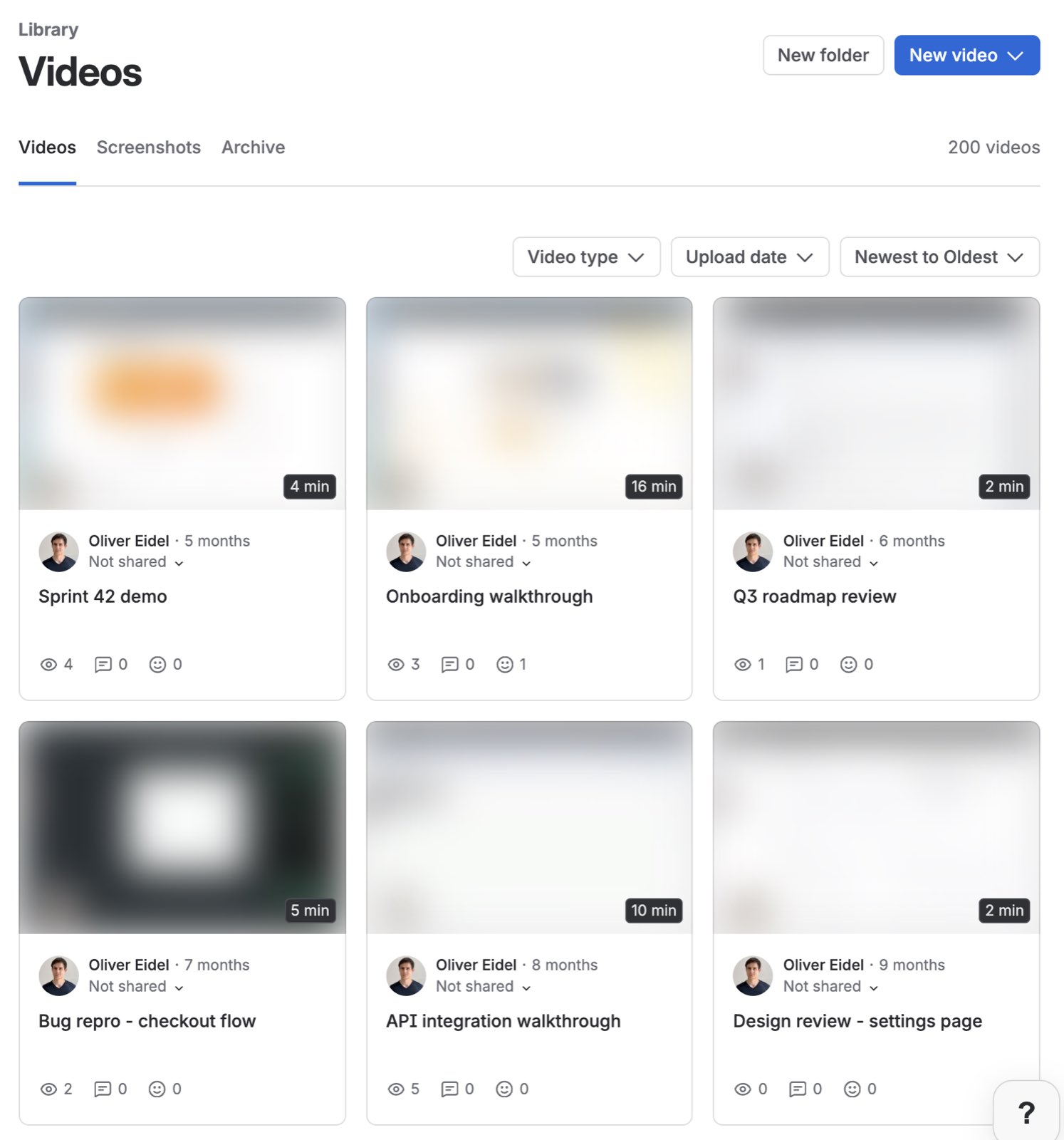
- Filter by owner or folder. Avoid mixing personal, shared, and company-owned recordings.
- Export an inventory. Even a simple sheet with title, URL, owner, created date, and decision creates accountability.
- Classify recordings. Use keep, migrate, archive, delete, and needs-owner-review.
- Run a small batch. Delete a handful of genuinely disposable videos and observe what the workspace does.
- Verify affected links. Check that archived and deleted items behave differently if you use both actions.
- Continue in named batches. Record who approved each batch and when it was removed.
Do not bulk-delete across an organization immediately before cancelling. Account closure, ownership changes, and plan downgrades can have different consequences; sequence the project so the replacement library is already working.
Deleting to get under Loom Starter’s limit
Loom Starter currently allows 25 videos per person with five-minute ordinary screen recordings. That is a library cap, not a monthly bucket that automatically resets. Deleting old videos may create capacity, but it also turns a useful knowledge base into a rotating buffer.
Before repeatedly deleting history, compare three options:
- keep Starter and reserve it for disposable recordings;
- pay for the Loom features and storage the team actually uses;
- migrate durable recordings to a tool or archive designed for the intended workflow.
Chairkick does not offer a permanent free tier to new workspaces. New accounts receive a 14-day Pro trial; Pro costs $9 per recorder monthly or $72 yearly, and ordinary share-link viewers do not need paid seats. If you are evaluating a move, test representative recordings through the Loom importer before changing the source library.
What happens to links and embedded videos?
Any page, ticket, knowledge-base article, or email containing the old Loom URL may now lead to an unavailable video. Search important systems for the share URL before deletion. For a migration:
- create the replacement recording or import;
- verify its permissions and playback;
- replace links in customer-facing and internal documentation;
- keep a URL mapping for links you cannot update immediately;
- delete the Loom original only after the replacement has been used successfully.
Embedded Loom players deserve special attention because a broken player can look like a website defect. Check high-traffic pages and onboarding flows manually.
When an account or employee is being removed
Do not solve an ownership problem by deleting the user first. Identify recordings the business must retain, transfer or migrate them while the owner still has access, and confirm the destination owner. Loom warns that permanently deleting a workspace member may also permanently delete videos associated with that profile.
For a subscription change, pair this guide with the cancellation checklist. The safest order is inventory, export or migrate, verify, replace links, then cancel or remove accounts.
A deletion checklist
Before the final confirmation, make sure:
- the recording is the intended one;
- its owner or an admin approved removal;
- any required MP4, transcript, comments, and metadata are preserved;
- the backup plays on another device;
- replacement links have been updated;
- the workspace’s recovery wording is understood;
- the deletion is recorded if the content matters to the business.
Deleting one disposable test video should take seconds. Deleting a working library is an information-migration project. Spend the extra few minutes on inventory and verification—the cost is tiny compared with recreating a walkthrough after its context has disappeared.