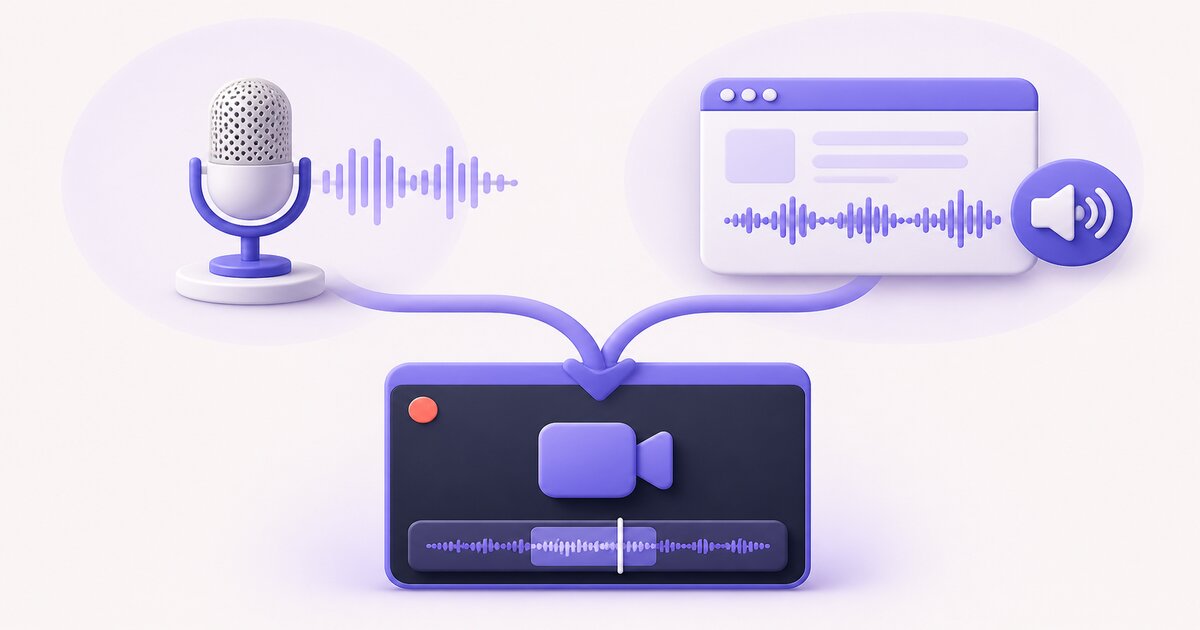
A screen recording can capture audio, but only the sources you enable and the operating system permits. Your voice comes from the microphone. Music, a demo app, or another speaker in a call comes from device, system, or browser-tab audio. A recorder can capture either source, both, or neither.
The safest habit is to make a ten-second test containing your voice and a known device sound, then play it back before recording the real walkthrough.
Microphone, system, and tab audio are different
| Source | What it captures | Common use | Common failure |
|---|---|---|---|
| Microphone | Your voice and sound in the room | Narration, interviews, explanations | Wrong input selected, permission denied, hardware muted |
| System or device audio | Sound produced by the computer or phone | App sounds, media, meeting participants | Recorder or app does not support capture; protected content blocks it |
| Browser-tab audio | Sound from one shared browser tab | Web demos, videos, browser-based calls | “Share tab audio” was not selected, or a window/screen was shared instead |
Want to make sure your test capture has the right audio? Try a quick mic check before your real recording. Test your microphone
Headphones do not prevent internal system or tab capture because that audio is copied digitally. They do reduce the chance that a microphone re-records speaker output and creates echo. If your tool cannot capture system audio, playing sound through speakers and catching it with the mic is a poor fallback: it adds room noise, echo, and lower quality.
Windows screen recording audio
Xbox Game Bar can include system audio and microphone audio. Open it with Windows + G, open Settings → Capturing, and select the desired audio scope. Microsoft’s current instructions use All to include app and system sounds. Toggle the microphone during recording with Windows + Alt + M.
Game Bar is designed around recording a game or application rather than every part of the Windows desktop. If the target window is unsupported, use Snipping Tool, Clipchamp, or a dedicated recorder and check the available audio toggles before starting.
When a Windows recording is silent:
- Confirm the volume mixer shows activity for the app being demonstrated.
- In Game Bar’s Audio widget, verify the intended output and input devices.
- Open Settings → Privacy & security → Microphone and allow access for desktop apps.
- Select All under Game Bar’s Capturing audio setting if app or system sounds are required.
- Make a short test while both speaking and playing a notification or video.
Mac screen recording audio
The built-in macOS Screenshot recorder opens with Shift + Command + 5. Under Options, choose a microphone to add narration. If no microphone is selected, the built-in capture can be silent.
Apple’s Screenshot instructions expose microphone selection but not a general system-audio input. For reliable app or system sound, use software that explicitly supports system audio on the installed macOS version, or capture a browser tab with its audio-sharing option. Some apps install an audio component or request additional Screen & System Audio Recording permission to make this possible.
Check System Settings → Privacy & Security for both Microphone and Screen & System Audio Recording access. Permission changes may require quitting and reopening the browser or recorder. macOS can remember a denied choice, so a recorder may look correctly configured while receiving no signal.
For a call, do not assume the built-in microphone will produce a clean copy of the other participants. With headphones it will usually capture only your voice; with speakers it may capture a low-quality, echo-prone version of the call through the room.
Chromebook screen recording audio
Current ChromeOS screen capture can record device audio, microphone, or both. This is important because older advice often says Chromebook’s built-in recorder cannot capture device sound; Google’s current documentation shows that it can.
Press Shift + Ctrl + Show windows or open Screen Capture from Quick Settings, choose Screen record, then open Settings. Select Device audio, Microphone, or Device audio and microphone. ChromeOS can also add a front-camera feed and show clicks and keys.
GIF capture does not contain audio. If you selected GIF rather than video, silence is expected. Standard recordings are saved as WebM files in Downloads or the folder selected in Screen Capture settings.
iPhone and iPad screen recording audio
Open Control Center and start Screen Recording to capture the screen. To add your voice, touch and hold the Screen Recording control, turn Microphone on, and then start. Apple explicitly documents the microphone step and notes that some apps do not allow their content to be recorded.
Device media may be present in the recording when the source app permits it, but do not rely on that for calls, streaming services, or protected media. App privacy and copyright controls can remove sound, video, or both. Test the exact app and workflow.
If narration is missing, repeat the long-press step and verify the microphone button is on. Also check Settings → Privacy & Security → Microphone for the relevant app, disconnect an unexpected Bluetooth input, and make sure the phone is using the intended microphone.
Android screen recording audio
On current Android devices, the start dialog commonly offers device audio, microphone, both, or no audio. The wording and available choices vary by manufacturer and Android version, so look for Record audio or Sound before tapping Start.
Apps can prevent internal sound capture. Video-call apps, banking apps, and DRM-protected streaming media are common examples. A recorder showing “device audio” does not override the source application’s security or privacy policy. If only one specific app is silent while other device sounds record correctly, the restriction is probably app-specific rather than a broken microphone.
For reliable instructions, use the phone manufacturer’s support page as well as Android guidance because Samsung, Google Pixel, and other vendors customize the recorder.
Browser screen sharing and tab audio
In Chromium-based browsers, choosing a browser tab usually gives the clearest tab-audio path. Select the tab and enable the share-audio checkbox. Sharing a window or an entire screen can expose different audio choices depending on the browser and operating system.
The browser still asks separately for microphone permission. A web recorder can therefore receive tab audio but no narration, or narration but no tab audio. Look for independent microphone and shared-audio meters or toggles.
If a demo includes only one web app, sharing that tab is often safer than sharing the entire desktop: notifications remain private and the audio source is easier to identify. If you must move between applications, use a recorder that explicitly supports system audio on your OS and run a test first.
Diagnose a silent recording
| Symptom | Likely cause | Next check |
|---|---|---|
| Voice missing, app sound present | Microphone off, denied, or wrong input | Input meter, OS mic permission, hardware mute, Bluetooth device |
| Voice present, app sound missing | System/tab audio not shared | Capture-source dialog and “share audio” option |
| Everything silent | No source enabled or player muted | Record a new ten-second test and play it in another player |
| Only one app is silent | App privacy or DRM restriction | Test an unprotected sound from another app |
| Echo or doubled voices | Speaker sound is entering the mic as well as digital capture | Wear headphones or disable one duplicate source |
| Sound drifts out of sync | Device load, Bluetooth latency, or recorder issue | Close heavy apps, use wired audio, shorten the test |
| Mic works in calls but not recorder | Recorder lacks OS or browser permission | Re-enable permission and restart the recorder |
Also verify that the recording file has an audio track rather than trusting a thumbnail preview. Try a second player, check its mute state, and inspect the waveform if an editor provides one.
A browser workflow with both sources
Chairkick records from a modern desktop browser. You choose a microphone and a screen or browser tab; when the browser offers shared audio, that source is mixed into the recording with narration. A preflight meter makes it possible to test the microphone before the real take. The resulting share page includes captions and a transcript after processing.
Browser and operating-system permission rules still apply, so Chairkick cannot capture audio an app or platform refuses to share. The useful difference is that the capture choices happen in one record-and-share workflow rather than requiring a local file and separate hosting. Try the microphone test before a high-stakes recording, or use the Chromebook recorder guide for a ChromeOS walkthrough.
Sources and fact check
Platform behavior was checked August 18, 2026 against official instructions for Xbox Game Bar, recording a Mac screen, iPhone screen recording, and Chromebook screen capture.